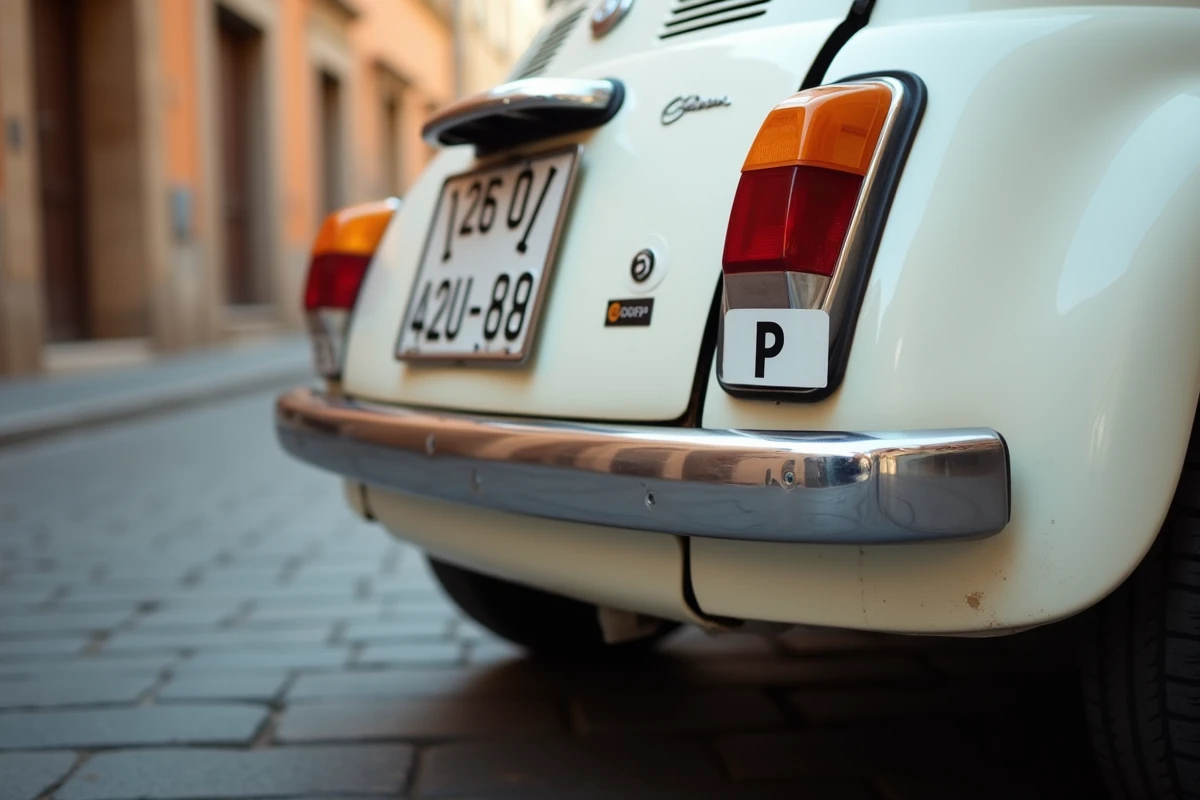
You are driving in Italy and you spot a white sticker with the letter “P” attached to the back of a car. No brand logo, no advertising slogan, just this clearly visible “P”. This sign intrigues many French drivers crossing the Alps or heading down to Tuscany. Understanding its meaning changes the way one perceives Italian traffic.
The Italian “P” does not indicate parking or a country
The first thought that comes to mind: “P” for parking, or as the country code “P” for Portugal. Neither of these. In Italy, “P” stands for “Principiante”, meaning beginner. It identifies a driver who has just obtained their driver’s license.
The principle is simple. After the exam, the young Italian driver must display this sign on their vehicle for a defined period. It signals to other road users that the person behind the wheel lacks experience. It is a road safety measure, not just a simple accessory.
To better understand what the “P” means on cars in Italy, it is essential to place this sign in the context of the Italian highway code, which frames young drivers more visibly than in France.
Driving rules related to the “P” for young Italian drivers
The “P” is not decorative. It comes with real constraints that limit what the beginner driver can do on the road.
Have you ever noticed that speed limits are not the same for all drivers? In Italy, the holder of the “P” drives with reduced speed limits compared to experienced motorists. On the highway, the maximum allowed speed is lower than that for experienced drivers. The same logic applies on roads outside urban areas.
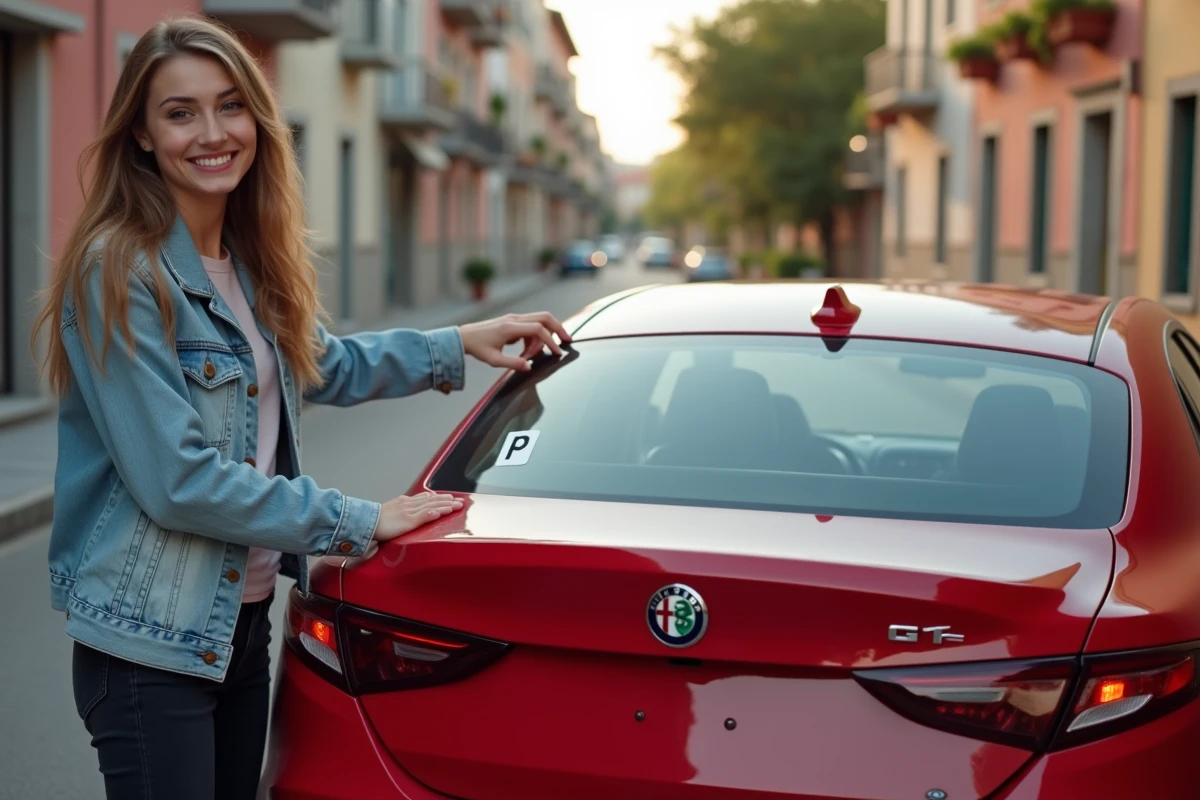
Beyond speed, other restrictions apply:
- Prohibition on driving overly powerful vehicles: the power-to-weight ratio of the vehicle is capped to prevent a beginner from driving a sports car
- Blood alcohol level set to zero, with no tolerance whatsoever, while experienced drivers have a slightly higher threshold
- Obligation to display the “P” at the front and back of the vehicle, under penalty of a fine in case of inspection
These rules are not optional. Italian law enforcement regularly checks for the presence of the sign and compliance with the associated limitations.
Differences between the Italian “P” and the French “A” for young drivers
In France, the “A” disc (for “Apprenti”) serves a comparable function. A young driver sticks it on the back of their car during the probationary period. The logic is the same: to signal a lack of experience.
The difference mainly lies in the regulatory framework surrounding each system. The Italian “P” imposes stricter vehicle power restrictions than the French “A”. In France, the limitations mainly concern speed and points. In Italy, access to certain categories of cars is physically restricted.
Another notable distinction: the “P” must be displayed at both the front and the back of the vehicle in Italy. In France, the “A” is placed only at the back. This dual display makes the beginner driver identifiable in both directions of traffic, which helps other users adjust their driving.
Why this difference in approach
Italy aims for maximum visibility of the beginner. The idea is that every motorist encountered or overtaken can anticipate potentially hesitant behavior. The French “A”, being more discreet, fulfills this function in a less direct way.
This Italian approach fits into a driving culture where visual signaling plays a predominant role. Limited traffic zones (ZTL), specific signs like the “NEBBIA” sign for fog, or different color codes for signage are all visual cues that Italian drivers learn to decode.
The “P” in Italy also applies to rental vehicles and tourists
Does a foreign driver on a probationary license who rents a car in Italy need to display the “P”? This question is becoming more common with the rise in automotive tourism.
The answer depends on the driver’s status. If your license is in a probationary period in your home country, the Italian restrictions may apply during an inspection. Italian car rental companies report increased attention from authorities on this point.
For tourists who are no longer in a probationary period, the “P” does not directly apply to them. However, encountering a vehicle displaying this sign provides useful information: keep your distance and anticipate sometimes hesitant maneuvers, especially in Italian city centers where traffic is dense.
Tips if you encounter a vehicle with the “P”
- Leave a wider safety distance than with an experienced driver
- Avoid aggressive honking that may destabilize a beginner in a stressful situation
- Anticipate sudden braking, especially when approaching roundabouts and complex intersections
The “P” is ultimately a communication tool between drivers. It transforms an invisible piece of information (the level of experience) into a clear and immediate signal. Whether driving in Italy for vacation or work, spotting this white sign allows for adjusting one’s driving and contributing to the safety of all on Italian roads.