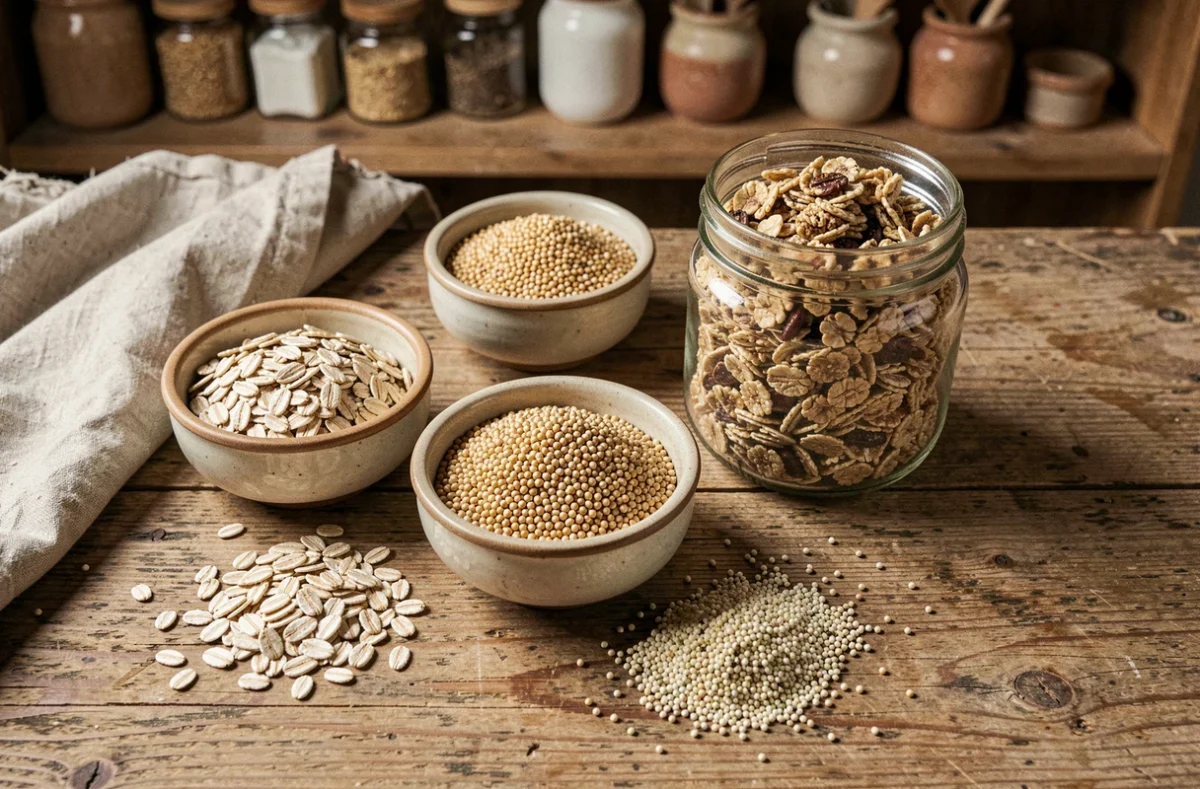
Not all cereals provide the same amount of energy per serving. Between a bowl of puffed corn flakes and a handful of nut granola, the caloric gap can exceed double. This ranking is based on the energy density per 100 g of dry product, the most reliable criterion for comparing cereals before even considering the actual size of the bowl.
1. Nut and Honey Granola
Granola tops this ranking. The mix of toasted oats, honey, and nuts (almonds, hazelnuts, cashews) concentrates a very high caloric density per 100 g. Baking with a fat and added sugar transforms a relatively moderate oat base into a significantly more energetic product.
The main trap lies in the portion size. Most consumers pour much more than the reference portion indicated on the packaging. As highlighted by articles from Monde Gourmandises, the difference between the displayed portion and the portion actually consumed explains a large part of the underestimated caloric intake at breakfast.
The revised Nutri-Score in 2025 penalizes these products even more: the enrichment in vitamins no longer compensates for a high sugar content. A granola labeled “organic” or “high in fiber” may therefore receive a less favorable rating than before the revision.
2. Crunchy Muesli with Dried Fruits
Crispy muesli differs from traditional muesli by a cooking step that brings it closer to granola. The addition of dried fruits (raisins, cranberries, apricots) increases the content of simple sugars and calories compared to raw, uncooked muesli.
The difference between raw muesli and crunchy muesli often exceeds 100 kcal per 100 g. Simply reading “crunchy” on the packaging is enough to identify this more caloric category.
3. Chocolate-Filled Cereals
Chocolate-filled cereals combine a shell of puffed wheat and a heart of chocolate paste. This double structure concentrates both quick carbohydrates and fats from the filling. The result: one of the highest caloric densities in the aisle.
These products frequently appear among those whose Nutri-Score has declined after the 2025 revision, due to the more unfavorable calculation for highly sugary and saturated fat-rich products.

4. Puffed Chocolate Cereals
Less caloric than filled cereals, puffed chocolate cereals still remain significantly above plain flakes. The added cocoa, coating sugar, and sometimes palm oil make it a product to watch for those looking to limit their energy intake.
Their apparent lightness plays a deceptive role: a large bowl weighs little on the scale but concentrates a significant amount of added sugars.
5. Oat Flakes
Oat flakes are surprising in this ranking. With a notable energy density per 100 g of dry product, they rank among the most caloric cereals. The difference with the previous products lies in the nature of these calories.
- Oat flakes contain complex carbohydrates with a moderate glycemic index, promoting a gradual release of energy
- Their soluble fiber content (beta-glucans) contributes to satiety and slows down sugar absorption
- They contain neither added sugar nor added fat in their raw version
A synthesis published in the European Heart Journal in September 2026 associates the daily consumption of whole grains, within a range of 60 to 100 g of dry weight, with cardiometabolic improvements. Oat flakes illustrate this paradox well: a caloric cereal can be nutritionally interesting.
6. Honey Puffed Wheat
Honey puffed wheat combines a base of processed wheat and a sweet coating. The caloric density is just below that of oat flakes, but the composition differs radically: mostly quick sugars, low fiber, and low satiety.
This is a typical case where simply reading the calories per 100 g masks a nutritional profile that is much less favorable than that of oats, despite a similar number.
7. Plain Puffed Rice
Plain puffed rice appears to have a moderate caloric density, but its high glycemic index and very low fiber content pose a satiety problem. A bowl of puffed rice often leaves hunger returning quickly, prompting more consumption in the morning.
Puffed rice illustrates the limit of reasoning based solely on calories: a product that is less caloric per 100 g can lead to greater overall overconsumption than a dense but satiating product.
8. Classic Corn Flakes
Corn flakes occupy an intermediate position. Their base of puffed and flattened corn generates an average caloric density, without massive sugar addition in the plain versions. However, their fiber content remains low, and their glycemic index is among the highest of all cereals.
Pairing corn flakes with a protein source (yogurt, cottage cheese) and a fresh fruit changes the game by slowing down carbohydrate absorption.
9. Puffed Buckwheat
Buckwheat is not a grass but a pseudocereal, naturally gluten-free. Its puffed version offers a caloric intake comparable to corn flakes, with a more complete nutritional profile: more plant proteins, a broader spectrum of amino acids, and a good magnesium content.
Puffed buckwheat remains a niche product, less available in supermarkets than oats or rice. It is more easily found in health food stores or bulk.
10. Barley Flakes
Barley flakes close this ranking with a caloric density slightly lower than that of oat flakes. Rich in beta-glucans like oats, they share the same properties of satiety and blood sugar regulation.
Their use remains uncommon at breakfast in France, more confined to cooking (soups, risottos). Incorporating them into a porridge or homemade muesli allows for varying sources of whole grains without sacrificing nutritional quality.
- The raw caloric ranking (per 100 g) does not reflect the actual nutritional quality of a cereal
- The portion actually consumed, fiber content, and glycemic index count as much as calories
- Since the revision of the Nutri-Score in 2025, enriched but highly sugary products are penalized more, making label reading more reliable than before
The most useful takeaway: comparing cereals based on 100 g dry only makes sense if the actual portion poured into the bowl is also considered. A granola consumed at 30 g and oat flakes at 60 g will not have the same effective caloric impact, despite a density difference on the label.